
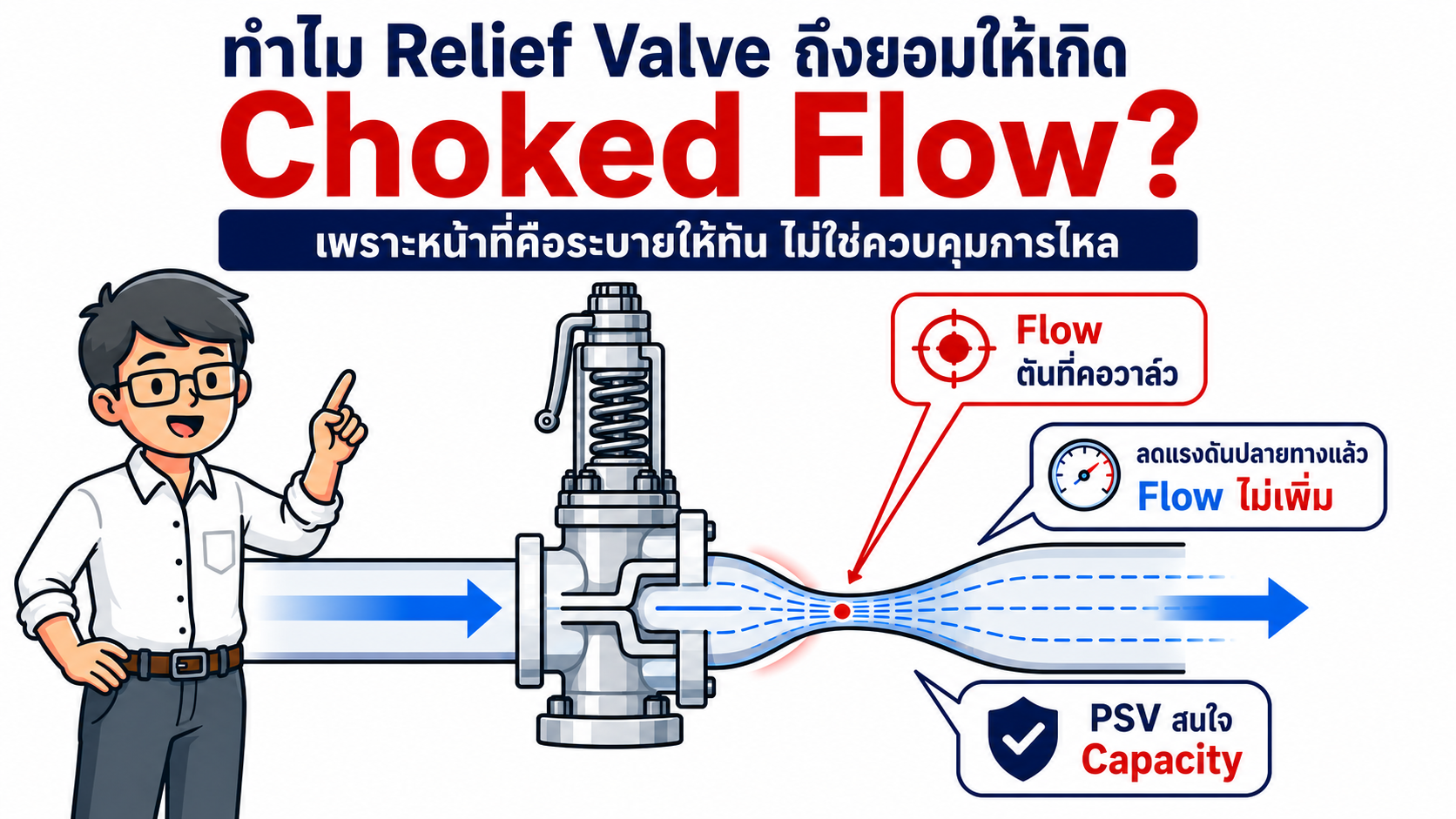
TL;DR — Relief Valve / PSV ไม่ได้ "พยายามหลีกเลี่ยง" Choked Flow แต่กลับ ยอมให้เกิด เพราะมันคือสภาวะที่ระบายของไหลได้เร็วที่สุดที่แรงดันต้นทางจะสามารถผลักออกไปได้ ภายใต้สภาวะ choked: โดย (≈ 0.528 สำหรับอากาศ) — Mach number ที่ throat = 1 และอัตราการไหลไม่ขึ้นกับ backpressure อีกต่อไป ทำให้ขนาดวาล์ว "predictable" สำหรับสภาวะฉุกเฉินที่ออกแบบเอาไว้
ทำไมถึงสำคัญ
เคยมีกรณีในโรงกลั่นแห่งหนึ่ง — วิศวกรหน้าใหม่ size PSV สำหรับ vapor relief แล้วใส่ correction factor (backpressure) ไม่ถูกต้อง เพราะคิดว่า "ของไหลจะ stick at the throat แล้ว flow จะลดลง" จึงเพิ่ม factor เผื่อไว้
ผลคือเลือก orifice ใหญ่เกินจริง 2 ขนาด (จาก K → P) ค่าวาล์วเพิ่มขึ้น 40% และเมื่อ trip จริง downstream piping ออกแบบไม่พอกับ flow rate ที่สูงเกิน — เกิด overpressure ที่ flare header แทน
ปัญหาคือเข้าใจผิดในธรรมชาติของ choked flow: มันไม่ใช่อุปสรรค มันคือ feature
1. Choked Flow คืออะไร?
เมื่อก๊าซไหลผ่าน restriction (เช่น orifice, throat, หรือ nozzle ของ PSV) และความเร็วของก๊าซที่จุดแคบที่สุดถึง ความเร็วเสียง (Mach 1) — สภาวะนี้เรียกว่า choked หรือ critical flow
หลังจาก choked แล้ว:
- ความเร็วที่ throat ไม่เพิ่มขึ้นอีก ไม่ว่าจะลด downstream pressure ลงเท่าไหร่
- Mass flow rate คงที่ ตามสมการ critical flow
- คลื่น pressure information จาก downstream ไม่สามารถวิ่งย้อนกลับขึ้นมาที่ throat ได้ (เพราะ Mach ที่ throat = 1 ทำให้คลื่นเสียงกลับสวนทางไม่ทัน)
เงื่อนไขทางคณิตศาสตร์
ก๊าซจะ choke เมื่อ pressure ratio ระหว่าง downstream/upstream ต่ำกว่า critical pressure ratio:
โดย:
- = stagnation pressure ที่ต้นทาง (= set pressure + overpressure allowance ใน PSV)
- = pressure ที่ downstream ของ throat
- = ratio of specific heats
ค่า สำหรับก๊าซทั่วไป
| ก๊าซ | choke เมื่อ | ||
|---|---|---|---|
| Air | 1.40 | 0.528 | 52.8% |
| Steam (superheated) | 1.33 | 0.546 | 54.6% |
| Steam (saturated, dry) | 1.135 | 0.577 | 57.7% |
| Methane | 1.31 | 0.546 | 54.6% |
| Hydrogen | 1.41 | 0.527 | 52.7% |
| CO₂ | 1.30 | 0.546 | 54.6% |
| Argon | 1.67 | 0.487 | 48.7% |
ตีความ: สำหรับอากาศ — ถ้า upstream อยู่ที่ 10 bar(a) และ downstream ต่ำกว่า 5.28 bar(a) → choked อัตโนมัติ
2. ทำไม PSV ถึง "ยอม" ให้เกิด Choked Flow?
มี 3 เหตุผลที่ทำให้ choked flow ไม่ใช่ปัญหาแต่เป็น คุณสมบัติที่ออกแบบไว้ตั้งใจ
เหตุผลที่ 1 — Mass flow ต่อพื้นที่หน้าตัดสูงสุด
ที่ choked condition อัตราการไหลเชิงมวลต่อพื้นที่ (mass flux, ) มีค่ามากที่สุด สำหรับ stagnation condition ที่กำหนด
PSV หน้าที่หลักคือ ระบายของไหลออกให้ทันก่อนที่ระบบจะรับแรงดันเกินกว่าจะรับได้ — ยิ่ง mass flux สูง ขนาด orifice ที่ต้องการก็ยิ่งเล็ก ราคาวาล์วถูก ตอบสนองเร็ว
เหตุผลที่ 2 — Decoupling จาก downstream
สภาวะ non-choked: flow rate ขึ้นกับทั้ง และ — ถ้า downstream piping มี pressure drop ที่ไม่คาดคิด หรือมี backpressure จาก flare header ระดับ flow rate จะเปลี่ยน → ทำนายไม่ได้
สภาวะ choked: flow rate ขึ้นกับ เพียงอย่างเดียว — downstream เปลี่ยนยังไงก็ไม่กระทบ (ตราบใดที่ยังคง choked) → predictable
สำหรับ safety device ที่ต้อง รับรองว่าจะระบายได้ตามที่คำนวณ ไม่ว่าระบบดาวน์สตรีมจะเป็นอย่างไร — Predictable คือคุณค่าสูงสุด
เหตุผลที่ 3 — Self-limiting in upset scenarios
ใน worst-case (fire case, blocked outlet) แรงดันต้นทางสูงขึ้นเรื่อยๆ จนชน set pressure → PSV เปิด → flow choked ทันที (เพราะ atmospheric หรือ flare header pressure ต่ำกว่า 50% ของ set อยู่แล้วในกรณีส่วนใหญ่)
ผลคือ ระบบไม่สามารถ "overflow" ระบาย PSV ได้ — แม้ภายในจะมีพลังงานสะสมมาก flow rate ที่ออกไปจำกัดด้วย choked condition และคำนวณได้ล่วงหน้า
3. สมการ Sizing ตาม API 520 Part I
API 520 Part I §5.6 แบ่งการ size PSV สำหรับก๊าซเป็น 2 กรณี — โดยพิจารณา pressure ratio:
กรณีที่ 1 — Critical Flow (Choked)
เมื่อ :
(US units; SI version มีค่าคงที่ต่างกัน — ดู API 520 ตาราง 9)
โดย:
- = required mass flow (lbm/hr หรือ kg/hr)
- = coefficient ขึ้นกับ (เช่น สำหรับ ใน US units)
- = discharge coefficient (≈ 0.975 conventional, 0.65 pilot)
- = backpressure correction (= 1.0 ในสภาวะ choked เพราะ backpressure ไม่กระทบ)
- = combination correction (= 1.0 ปกติ, 0.9 ถ้ามี rupture disk upstream)
- = relieving pressure (= set + accumulation, abs)
- = relieving temperature (R หรือ K)
- = compressibility factor
- = molecular weight
สังเกตว่า — เป็น proof ทางคณิตศาสตร์ว่า backpressure ไม่กระทบเมื่อ choked
กรณีที่ 2 — Subsonic Flow (Non-choked)
เมื่อ :
โดย:
- = subsonic flow factor (function ของ และ pressure ratio)
- = backpressure (abs)
ในกรณีนี้ backpressure เข้ามาในสูตรโดยตรง — และ flow rate ขึ้นกับทั้ง upstream และ downstream
ทำไมมี 2 สมการ?
เพราะ physics ต่างกันที่ choking threshold:
- ก่อน choke: ก๊าซขยายตัวต่อเนื่อง pressure ratio drives flow
- หลัง choke: ก๊าซขยายตัวด้วยความเร็วสูงสุดแล้ว → flow ขึ้นกับแค่ upstream stagnation
สมการที่ 1 simpler และ predictable — เป็นเหตุผลที่วิศวกร PSV ชอบ ให้ระบบทำงานในโซน choked
4. ผลในทางปฏิบัติ — ออกแบบยังไง?
✅ ดี — โซน choked
ส่วนใหญ่ของ PSV ใน gas service อยู่ในโซน choked โดยธรรมชาติ เพราะ:
- Discharge ไป atmosphere → bar(a) ≪ 50% ของ set pressure
- Discharge ไป flare header → backpressure 0.3-1.5 bar(g) ยังต่ำกว่า threshold
Design implication: ใช้ conventional PSV ได้ ราคาถูก ()
⚠️ ระวัง — Backpressure สูง
ถ้า downstream piping/flare header มี backpressure สูงพอที่จะหลุดออกจาก choked zone:
สำหรับ conventional PSV:
- Built-up backpressure ≤ 10% ของ set pressure → safe
- เกิน 10% → spring force ไม่พอ ทำให้วาล์วปิดไม่สนิท chattering
ทางออกเมื่อ backpressure > 10%:
- ใช้ Balanced bellows PSV — bellows ปกป้อง disc area จาก backpressure → ทนได้ถึง 50%
- ใช้ Pilot-operated PSV — sensing line จับ upstream pressure โดยตรง → ทนได้ถึง 70-90%
📊 Decision matrix
backpressure / set pressure | recommended PSV type
─────────────────────────────────────────────────
< 10%                       | Conventional (cheapest)
10% – 50%                   | Balanced bellows
> 50%                       | Pilot-operated
5. Worked Example
โจทย์: PSV ระบาย air จากถัง upstream
- Set pressure = 10 bar(g) → = 11 + 10% accumulation ≈ 12.0 bar(a)
- Backpressure = atmosphere → = 1.013 bar(a)
- Required flow = 5,000 kg/hr
- = 60°C = 333 K, = 29, ≈ 1.0, = 1.4
Step 1 — Check choked condition:
→ Choked ✓ ใช้สมการ critical flow
Step 2 — คำนวณ orifice area (SI units, API 520 ตาราง 9):
กับค่า (สำหรับ ใน SI units), , :
Step 3 — เลือก API 526 orifice letter:
- L = 2.853 in² → เลือก L (ใหญ่ที่สุดที่ใกล้และไม่ต่ำกว่า)
Step 4 — ตรวจสอบ:
ข้อสังเกต: ตอนที่ valve เปิด air จะ choke ทันทีเพราะ atmospheric pressure ≪ 50% × 12 bar(a) — เราไม่ต้องคิด correction สำหรับ backpressure เลย ()
6. ความเข้าใจผิดที่พบบ่อย
❌ "Choked flow คือ flow ที่ติดขัด"
ถูกต้อง: Choked flow คือ flow ที่ เร็วที่สุดที่ก๊าซจะวิ่งผ่าน restriction ได้ ที่ Mach 1 ที่ throat — มันไม่ใช่การ "ติด" แต่เป็น "limit ของ compressible flow physics"
❌ "ลด backpressure ลงอีก จะเพิ่ม flow rate"
ถูกต้อง: เมื่อ choked แล้ว — flow rate ไม่เพิ่ม ไม่ว่า backpressure จะลดลงเท่าไหร่ ของไหลที่ throat วิ่งเสียงแล้ว เร็วกว่านี้ไม่ได้ (อย่างน้อยที่ throat ตัวเดียวกัน)
❌ "ออกแบบให้หลีกเลี่ยง choked เลย"
ถูกต้อง: ตรงข้าม — วิศวกรอยาก อยู่ในโซน choked เพราะ predictable และ K_b = 1.0 (ไม่ต้องแก้ correction factor)
❌ "ใส่ K_b > 1.0 เผื่อ choked"
ถูกต้อง: คือ correction ต่ำลง จาก 1.0 เมื่อ subsonic — เมื่อ choked พอดี ใส่ค่าเกินทำให้ undersize valve (ผิดทางตรงข้าม)
7. สรุป — Decision Tree
flowchart TD
Start["PSV sizing<br/><span style='font-size:12px;opacity:0.7'>gas / vapor service</span>"]
Check{"P<sub>b</sub> / P<sub>1</sub> vs r*"}
Choked["<b>CHOKED</b><br/><span style='font-size:12px;opacity:0.75'>Critical flow</span><br/>Eq. 5.7 · K<sub>b</sub> = 1.0"]
Subsonic["<b>SUBSONIC</b><br/><span style='font-size:12px;opacity:0.75'>Non-critical flow</span><br/>Eq. 5.8 · K<sub>b</sub> < 1.0"]
Select["<b>เลือก API 526 orifice letter</b><br/><span style='font-size:12px;opacity:0.85;letter-spacing:0.04em'>D · E · F · G · H · J · K · L · M · N · P · Q · R · T · T2</span>"]
Start --> Check
Check -->|"≤ r*"| Choked
Check -->|"> r*"| Subsonic
Choked --> Select
Subsonic --> Select
%% Brand-aligned palette: cream/ink base + a desaturated sage for the
%% preferred path (choked) and warm-tan for the cautious path (subsonic).
%% The terminal box uses brand orange to anchor the conclusion.
classDef chokedStyle fill:#eef3e6,stroke:#5a7d4a,stroke-width:1.75px,color:#2d4a2b
classDef subsonicStyle fill:#f7ecdd,stroke:#a87a47,stroke-width:1.75px,color:#5b4023
classDef defaultBox fill:#ffffff,stroke:#141413,stroke-width:1.5px,color:#141413
classDef terminal fill:#141413,stroke:#141413,stroke-width:1.5px,color:#fbf7f4
class Choked chokedStyle
class Subsonic subsonicStyle
class Start,Check defaultBox
class Select terminal8. Take-away
- Choked flow เป็น default state ของ PSV ใน gas service — เพราะ atmospheric/flare backpressure มักต่ำกว่า critical ratio
- ในโซน choked ของไหลที่ออกขึ้นกับแรงดันต้นทางเท่านั้น — backpressure ไม่กระทบ → predictable
- API 520 มี 2 สมการ — Eq. 5.7 (choked) และ Eq. 5.8 (subsonic) เลือกตาม vs
- ออกแบบให้อยู่ในโซน choked — ใช้ conventional valve () ราคาถูก
- เมื่อ backpressure สูง ใช้ balanced bellows (≤ 50%) หรือ pilot-operated (≤ 70-90%)
ลองใช้เครื่องคำนวณ PSV ของเรา
เครื่องคำนวณ Relief Valve ของ DekEn ทำตาม API 520 Part I เต็มรูปแบบ — รวมการตรวจสอบ choked/subsonic อัตโนมัติ + เลือก API 526 orifice letter ให้
เอกสารอ้างอิง
- API Standard 520 Part I — "Sizing, Selection, and Installation of Pressure-relieving Devices: Part I — Sizing and Selection" (2020, 10th ed.) §5.6, §5.7
- API Standard 526 — "Flanged Steel Pressure-relief Valves" (2017, 7th ed.) — Orifice letter dimensions
- API Standard 521 — "Pressure-relieving and Depressuring Systems" (2020, 7th ed.) §4.4 — Fire case sizing
- John, J.E.A., Keith, T.G. — "Gas Dynamics" (2006) Ch. 5 — Choked flow theory
- Crane Technical Paper No. 410 — "Flow of Fluids Through Valves, Fittings, and Pipe" (2018) §3-4